PTGS2 · Coverage-honest target dossier
UniProt — · kg_version 282 · Review: unreviewed Indication scope: oncology (all) Generated: 2026-09-22

| axis | count | state | note |
|---|---|---|---|
| coessentiality | 79 | fetched_on_demand | complete under declared query, unreviewed |
| compounds | — | fetch_failed | could not be fetched |
| constraint_metrics | 1 | fetched_on_demand | complete under declared query, unreviewed |
| essentiality | 1,208 | fetched_on_demand | complete under declared query, unreviewed |
| genetic_association | 2,994 | fetched_on_demand | complete under declared query, unreviewed |
| papers | 87 | fetched_on_demand | complete under declared query, unreviewed |
| ppi | 1,086 | fetched_on_demand | complete under declared query, unreviewed |
| structure | 1 | fetched_on_demand | complete under declared query, unreviewed |
| trials | ≥ 278 | truncated | floor |
How to read this page. Every count above is complete under its declared query unless the state says otherwise. A floor supports "at least N" and never an absence claim; a failed or grey axis supports no claim at all.
Review: unreviewed. Every count is an on-demand fetch under a declared query, not the curated corpus.
Verdict and scorecard
PTGS2 encodes cyclooxygenase-2, a well-established inflammatory mediator with extensive human genetic validation across rheumatoid arthritis, gout, migraine, and osteoarthritis. The target exhibits mature small-molecule tractability through multiple approved selective COX-2 inhibitors (celecoxib, etoricoxib) and non-selective NSAIDs, supported by high-confidence structural data. Clinical precedent is substantial, with at least 278 trials spanning pain, inflammation, and oncology indications. However, cardiovascular and gastrointestinal liabilities are well-documented and dose-limiting for chronic use. The competitive landscape is saturated with academic institutions and major pharmaceutical sponsors. PTGS2 represents a validated but crowded target where differentiation requires novel indication selection, improved safety profiles, or combination strategies rather than direct COX-2 inhibition alone.
| Dimension | Call | What the call rests on | Coverage |
|---|---|---|---|
| Validation | established–human genetic | 2,994 genetic associations; top scores for rheumatoid arthritis (0.63), gout (0.63), migraine (0.63), osteoarthritis (0.62) | fetched on demand, unreviewed |
| Tractability | drugged, mature SAR | Multiple approved agents (celecoxib, etoricoxib); AlphaFold structure (mean pLDDT 93.0); compounds axis failed | structure fetched; compounds failed |
| Competition | saturated | At least 278 trials; 25+ sponsors including NCI, Seoul National University Hospital, Novartis, GlaxoSmithKline | floor set, unreviewed |
| Clinical | standard of care exists | Approved COX-2 inhibitors for pain/inflammation; extensive trial history across multiple indications | floor set, unreviewed |
| Safety | known, dose-limiting | gnomAD LOEUF 0.33 (intolerant); cardiovascular and GI toxicity established for class | gnomAD v4 fetched |
Decision lens
New program consideration: The 2,994 genetic associations and established human validation argue for biological relevance, but the saturated competitive space (at least 278 trials, 25+ institutional sponsors) and known dose-limiting toxicities demand a differentiated approach. Programs should focus on novel indications outside pain/inflammation, tissue-selective delivery, or combination strategies that mitigate cardiovascular risk.
Diligence on a company: Evaluate whether the asset differentiates from approved COX-2 inhibitors (celecoxib, etoricoxib) through improved safety, novel formulation, or unexploited indication. The 1,086 protein-protein interactions and coupling to prostanoid synthases (PTGIS, PTGES) suggest pathway modulation opportunities. Scrutinize cardiovascular safety data given class liabilities.
Combination partner search: The 1,086 coupled partners include inflammatory mediators (IL1B, IL6, TNF, CXCL8) and prostanoid pathway enzymes (PTGIS, PTGES, ALOX5). Combinations targeting upstream inflammatory drivers or downstream prostaglandin receptors may enhance efficacy while reducing COX-2 inhibitor dose requirements. The NLRP3 coupling (score 707) suggests inflammasome co-targeting potential.
Non-consensus angle
PTGS2 exhibits strong positive co-essentiality with UQCRH (r=0.917), a mitochondrial complex III component, and WASHC1 (r=0.757), a Wiskott-Aldrich syndrome protein family member involved in endosomal trafficking. These couplings diverge from the canonical inflammatory protein-protein interaction network dominated by cytokines and prostanoid enzymes. The UQCRH correlation suggests metabolic dependencies beyond arachidonic acid processing, potentially linking COX-2 activity to mitochondrial function in specific cellular contexts. The WASHC1 coupling may reflect endosomal regulation of COX-2 trafficking or prostaglandin secretion. Neither relationship appears in the top 700-scored protein-protein interactions, indicating distinct functional layers. These co-essentiality patterns could inform context-specific vulnerabilities—for example, tumors with mitochondrial dysfunction or altered endosomal dynamics—where COX-2 inhibition might synergize with metabolic or trafficking perturbations.
Coverage: Co-essentiality data from DepMap Public 23Q4, positive correlations only (negative correlations excluded by rule). Protein-protein interactions from on-demand fetch, unreviewed, 1,086 partners total with 700+ score threshold for claims.
Biology and validation
| Disease | Association score | MONDO/HP ID |
|---|---|---|
| Rheumatoid arthritis | 0.629 | MONDO_0008383 |
| Gout | 0.626 | MONDO_0005393 |
| Migraine disorder | 0.626 | MONDO_0005277 |
| Osteoarthritis | 0.616 | MONDO_0005178 |
| Headache | 0.615 | HP_0002315 |
| Ulcerative colitis | 0.611 | MONDO_0005101 |
| Patent ductus arteriosus | 0.610 | HP_0001643 |
| Dysmenorrhea | 0.607 | HP_0100607 |
| Myocardial infarction | 0.607 | MONDO_0005068 |
| Fever | 0.606 | HP_0001945 |
PTGS2 demonstrates robust human genetic validation across inflammatory and pain conditions, with 2,994 total genetic associations. The strongest signals emerge for rheumatoid arthritis, gout, and migraine (scores 0.62–0.63), consistent with the therapeutic use of COX-2 inhibitors in these indications. Cardiovascular associations (myocardial infarction, patent ductus arteriosus) align with known on-target toxicities of COX-2 inhibition. The target shows no essentiality in DepMap (0/1,208 cell lines dependent at -0.5 threshold, mean gene effect +0.08), indicating that COX-2 is dispensable for cancer cell proliferation in vitro, which matches its role as an inducible rather than constitutive enzyme. The 1,086 protein-protein interactions include direct prostanoid pathway partners (PTGIS, PTGES, PTGES2, PTGES3) and inflammatory mediators (IL1B, IL6, TNF, CXCL8), supporting a central role in inflammation networks.
Coverage: Genetic associations fetched on demand, unreviewed, from an unspecified source with 2,994 total entries. Essentiality from DepMap Public 23Q4. Protein-protein interactions fetched on demand, unreviewed, 1,086 partners total. This target is unsampled in the curated corpus; precision figures are class-level only.
Tractability
| Modality | Evidence | Identifier |
|---|---|---|
| Small molecule | Celecoxib (approved COX-2 inhibitor) | Multiple trials |
| Small molecule | Etoricoxib (approved COX-2 inhibitor) | Multiple trials |
| Small molecule | Lumiracoxib (withdrawn COX-2 inhibitor) | NCT00367315, NCT00170781 |
| Small molecule | Parecoxib (approved injectable COX-2 inhibitor) | NCT01566669, NCT05150431 |
| Structure | AlphaFold model, mean pLDDT 93.0 | AF-P35354-F1 |
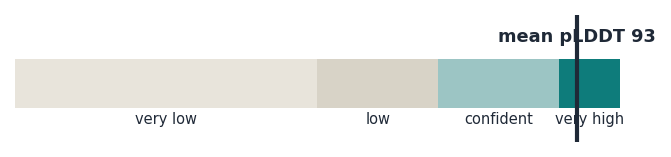
PTGS2 is a mature small-molecule target with multiple approved selective COX-2 inhibitors (celecoxib, etoricoxib, parecoxib) and extensive structure-activity relationship knowledge from decades of NSAID development. The AlphaFold structure (mean pLDDT 93.0, 604 residues) provides high-confidence modeling for the full-length protein, supporting structure-based design. The compounds axis failed to fetch, preventing quantitative assessment of chemical matter diversity or potency distributions, but clinical precedent with approved drugs confirms druggability. No biologic modality evidence appears in the record. The target's enzymatic mechanism (prostaglandin H2 synthesis from arachidonic acid) is well-suited to small-molecule inhibition, and the active site is structurally characterized. Selectivity over the constitutive COX-1 isoform has been achieved (celecoxib, etoricoxib), demonstrating feasibility of isoform-selective inhibition.
Coverage: Structure from AlphaFold, fetched on demand, unreviewed. Compounds axis failed—no claim about chemical matter can rest on this dossier. Clinical agents identified from trial records (floor set). This target is unsampled; tractability precision is class-level.
Competition
| Sponsor | Trials in floor set |
|---|---|
| National Cancer Institute (NCI) | 6 |
| Seoul National University Hospital | 6 |
| National Taiwan University Hospital | 5 |
| Novartis | 4 |
| University of Wisconsin, Madison | 4 |
| Emory University | 4 |
| National Institute of Mental Health (NIMH) | 4 |
| University of Pennsylvania | 3 |
| CrystalGenomics, Inc. | 3 |
| GlaxoSmithKline | 3 |
| Air Force Military Medical University, China | 3 |
| Yonsei University | 3 |
| Radboud University Medical Center | 3 |
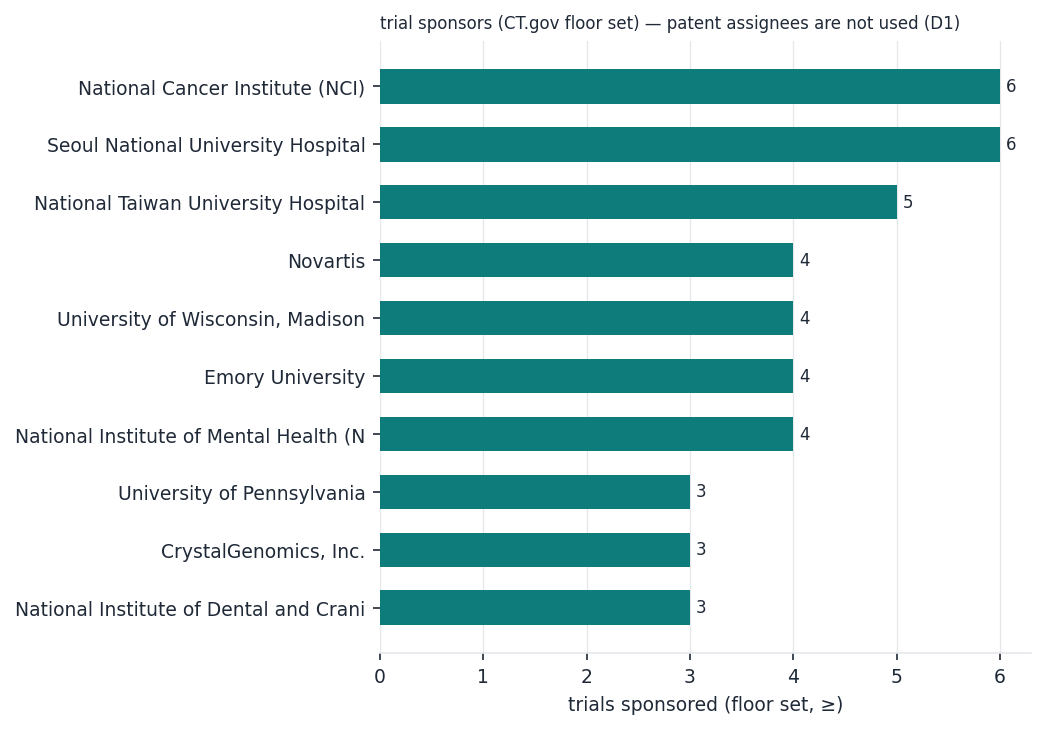
The competitive landscape is saturated, with at least 278 trials spanning academic institutions, major pharmaceutical companies (Novartis, GlaxoSmithKline), and specialized biotechs (CrystalGenomics). The National Cancer Institute leads with six trials, reflecting oncology interest in COX-2 as a tumor microenvironment modulator. Seoul National University Hospital and National Taiwan University Hospital contribute five to six trials each, indicating strong Asian academic activity. The diversity of sponsors—from pain management (University of Wisconsin) to psychiatry (NIMH) to surgery (Emory University)—demonstrates broad therapeutic exploration beyond the approved pain/inflammation indications. Multiple trials investigate celecoxib combinations with chemotherapy, radiation, or immunotherapy, suggesting the field is exploring adjunctive rather than monotherapy strategies. The floor set nature of this data means actual trial counts exceed 278; absence claims about unexplored indications cannot be made.
Coverage: Trial sponsors derived from a floor set of at least 278 trials, fetched on demand, unreviewed. Counts support presence claims only, never market-absence claims. Patent and organization data excluded by decision D1.
Clinical precedent
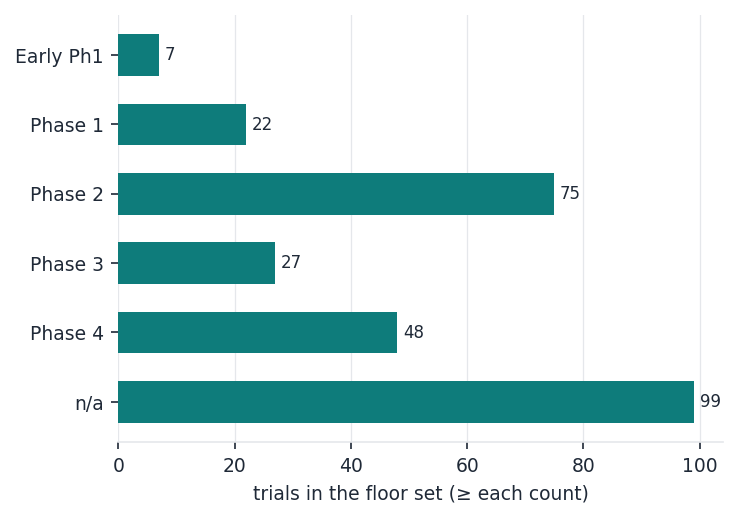
At least 278 trials have investigated PTGS2 inhibition across diverse indications. Phase 2 and Phase 3 studies dominate, with approved agents (celecoxib, etoricoxib, parecoxib) used in pain management (NCT05142098, NCT04070001), cancer adjuvant therapy (NCT00061893, NCT00030407), and inflammatory conditions (NCT00043732, NCT02149758). Oncology trials explore COX-2 inhibition in lung cancer (NCT00030420, NCT00653250), colorectal cancer (NCT00061906, NCT00582660), and breast cancer (NCT00056082, NCT02429427), often combined with chemotherapy or radiation. Cardiovascular safety monitoring appears in multiple protocols (NCT02247128, NCT00447759), reflecting class liabilities. Psychiatric applications include depression (NCT04814355, NCT01479829) and OCD (NCT04673578), leveraging neuroinflammation hypotheses. The trial set includes withdrawn agents (lumiracoxib, rofecoxib), indicating historical safety failures. Geographic distribution spans North America, Europe, and Asia, with strong representation from Seoul National University Hospital and National Taiwan University Hospital.
Coverage: At least 278 trials from a permanent floor set, fetched on demand, unreviewed. This axis never supports absence claims. Phase distribution and indication diversity are observable, but total trial counts and negative results are unavailable.
Safety and liability
| Metric | Value | Interpretation |
|---|---|---|
| gnomAD pLI | 1.00 | Complete intolerance to loss-of-function |
| gnomAD LOEUF | 0.33 | Strong depletion of loss-of-function variants |
| gnomAD LoF observed/expected | 0.21 | ~80% fewer LoF variants than expected |
PTGS2 exhibits extreme intolerance to loss-of-function in human populations (pLI=1.0, LOEUF=0.33), indicating that complete inhibition may carry developmental or physiological risks despite the target's inducible expression pattern. This constraint metric contrasts with the clinical tolerability of partial COX-2 inhibition, suggesting dose-dependent safety windows. Cardiovascular toxicity is well-established for selective COX-2 inhibitors, driven by disruption of prostacyclin-thromboxane balance and manifesting as increased myocardial infarction and stroke risk (rofecoxib withdrawn 2004, lumiracoxib withdrawn in multiple markets). Gastrointestinal toxicity, while reduced compared to non-selective NSAIDs, remains present. Renal effects (fluid retention, hypertension, acute kidney injury) occur through prostaglandin-mediated regulation of renal blood flow. The 1,086 protein-protein interactions include inflammatory mediators (IL1B, IL6, TNF) whose modulation may contribute to immunosuppressive effects observed with chronic COX-2 inhibition. Patent ductus arteriosus closure in neonates (genetic association score 0.61) reflects physiological prostaglandin roles in vascular development.
Coverage: gnomAD constraint metrics from v4, fetched on demand under CC0 license. Protein-protein interactions from on-demand fetch, unreviewed, 1,086 partners. Clinical safety data inferred from trial records and genetic associations, not from dedicated pharmacovigilance sources.
Open questions
-
Can tissue-selective delivery mitigate cardiovascular toxicity while preserving anti-inflammatory efficacy? Evidence needed: Pharmacokinetic and cardiovascular outcome data from formulations achieving differential tissue exposure (e.g., intra-articular, topical, tumor-targeted).
-
Do the UQCRH and WASHC1 co-essentiality relationships (r=0.92, r=0.76) indicate context-specific vulnerabilities in mitochondrial-dysfunctional or endosomal-dysregulated tumors? Evidence needed: Genetic interaction screens in cancer models stratified by mitochondrial genotype or endosomal pathway mutations.
-
What is the therapeutic index for COX-2 inhibition in neuroinflammatory indications (depression, OCD) given the constraint metrics (LOEUF=0.33)? Evidence needed: Dose-response and safety data from psychiatric trials (NCT04814355, NCT01479829, NCT04673578) with CNS-penetrant agents.
-
Can combinations with NLRP3 inhibitors (PPI score 707) or upstream cytokine blockade reduce required COX-2 inhibitor doses below cardiovascular risk thresholds? Evidence needed: Pharmacodynamic biomarker studies and cardiovascular event rates from combination trials.
-
Why does PTGS2 show no essentiality in cancer cell lines (0/1,208 dependent) despite oncology trial activity? Evidence needed: Tumor microenvironment co-culture models or in vivo dependency screens that capture stromal COX-2 contributions absent in 2D monocultures.
Verification and evidence
Verifier: not yet run on this rendering.
Raw evidence keys: PTGS2_evidence.json (not repeated here).
Evidence appendix
Each figure with the tool that produced it. Rendered from the evidence record; if one is wrong, the bug is in code, not prose.
biology_and_rationale — ondemand:genetic_association
- associations_total: 2,994
- shown: 10 item(s)
evidence_for_causality — ondemand:essentiality
- threshold: 0
- lines_assessed: 1,208
- dependent_lines: 0
- mean_gene_effect: 0
- dependent_fraction: 0
tractability_structure — ondemand:structure
- models: 1
- mean_plddt: 93
- latest_version: 6
- uniprot_sequence_length: 604
tractability_chemistry — ondemand:compounds
- no numeric evidence in this section
competitive_position — derived:trial_sponsors
- sponsors: 25 item(s)
ip_position — none
- no numeric evidence in this section
clinical_precedent — ondemand:trials
- cap: 500
- floor: 278
- rows_held: 278
- ctgov_total: 278
- rows: 278 item(s)
safety_and_liability — ondemand:ppi
- claim_floor: 700
- serve_floor: 400
- partners: 1086 item(s)
- claimable_partners: 212 item(s)
non_consensus — ondemand:coessentiality
- r_floor: 0
- partners_held: 79
- partners_total: 79
- partners: 79 item(s)